
C3M: An IR Payload in 1U, and the Constellation It Would Take
Paper SSC26-P2-24, 40th Annual Small Satellite Conference. Authored by Miguel Nunes, Noah Thompson, Jharrell Sim, Samantha Mallari, Dennis Sarsozo Jr., Junjie Huang, Jaycee Hasegawa, Mari Murillo, and Paul Lucey at the Hawaiʻi Space Flight Laboratory. This is a short pointer — the paper has the full treatment.
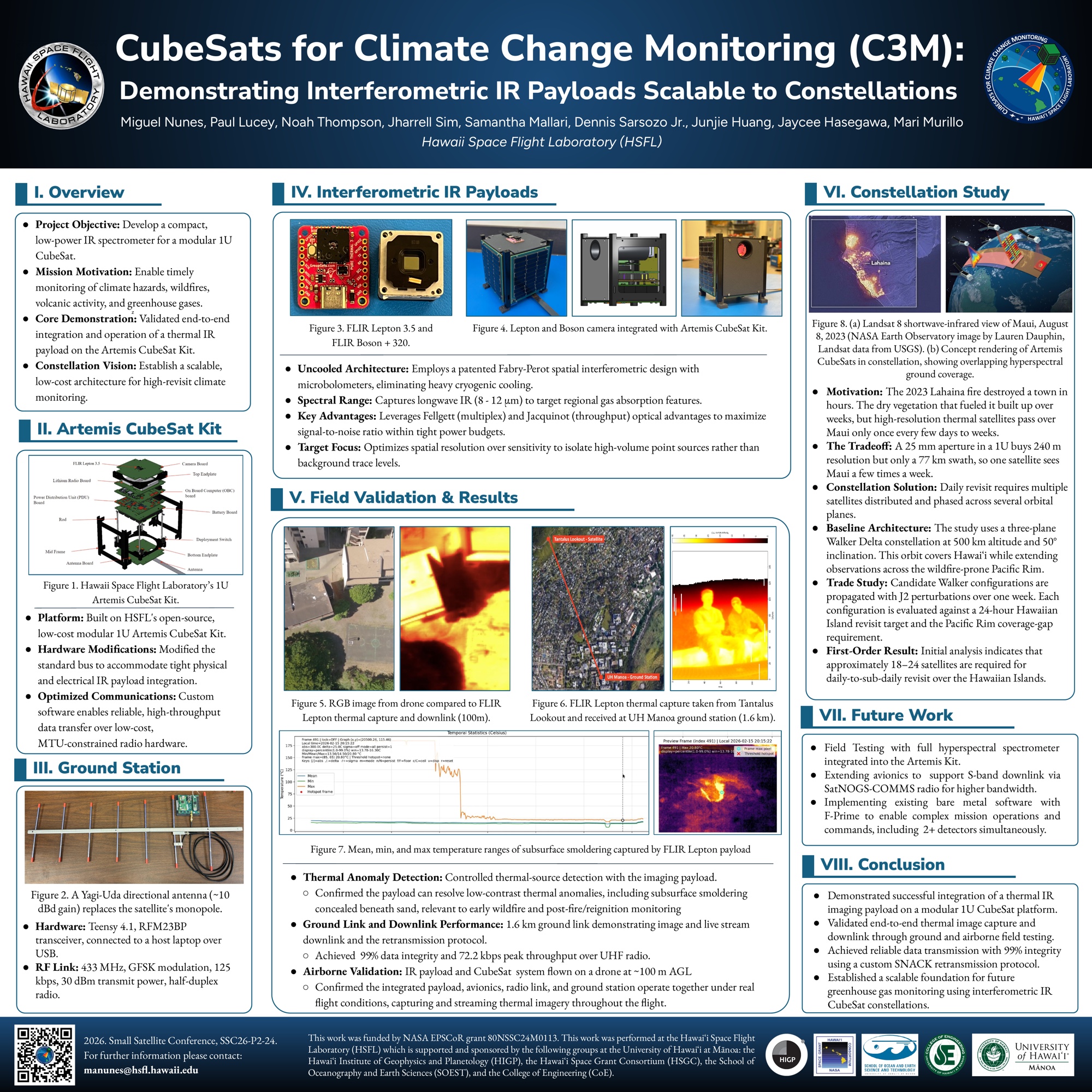
My contribution sits in the embedded software and the end-to-end data path; the payload research, optical design, and constellation study are the work of the broader team.
The gap
Hawaiʻi concentrates a set of climate monitoring problems: episodic volcanic CO₂, CH₄, and SO₂ from the Big Island, and fast-moving wildfires across dry terrain — the 2023 Lahaina fire overran a populated town within hours.
These events share a structural problem. They evolve within hours, but the orbital assets that could characterize them revisit any given point in days to weeks. MODIS, Landsat, and Sentinel were built for other jobs; dedicated greenhouse-gas missions carry costs and timelines that make constellation scaling impractical.
CubeSat constellations could close that gap. What was unproven is whether a 1U can host a capable IR imaging payload and reliably move its data to the ground — the foundation any interferometric spectrometer needs before it can fly. This paper establishes that foundation.
The instrument
The target payload is a miniaturized IR spectrometer on a patented Fabry–Perot spatial interferometric architecture by Dr. Paul Lucey, paired with uncooled microbolometer arrays covering 2.5–12 µm without cryogenic cooling. It draws on the Fellgett (multiplex) and Jacquinot (throughput) advantages to get useful spectral sensitivity inside a 1U power budget.
That instrument is still in development. The current build uses a FLIR Lepton 3.5 as a first-stage stand-in — not the science instrument, but a way to prove out bus integration, data handling, and the downlink path the real detector will inherit. C3M is an active maturation effort, not a frozen mission.
What was validated
- Thermal anomaly detection — hotspots from a controlled open flame, and from subsurface smoldering concealed beneath sand. The concealed case is the demanding one, and it is the signature early wildfire and reignition monitoring depends on.
- Ground link — end-to-end image downlink over 1.6 km at 99% data integrity and 72.2 kbps peak throughput, using the SNACK retransmission protocol.
- Airborne — the integrated payload flown on a drone at ~100 m AGL under remote command, capturing imagery and streaming live thermal video, with GPS and IMU telemetry time-stamped to each frame for geolocation.
The airborne test is the convincing one, because payload, avionics, radio link, and ground station all had to work together in motion.
Sizing the constellation
One satellite cannot meet the temporal goals, so the study asks how many are needed for useful revisit over Hawaiʻi and the Pacific. The geometry is sized around the upgraded detector — a FLIR Boson+ 320 with a custom in-house lens, 25 mm in diameter.
That aperture is the controlling constraint, and it binds in an interesting way: at longwave IR, diffraction limits resolution more than pixel geometry does.
| Altitude | GSD | Cross-track swath |
|---|---|---|
| 460 km | ~220 m | ~71 km |
| 500 km | ~240 m | ~77 km |
| 600 km | ~290 m | ~92 km |
The narrow swath drives everything. A ~77 km footprint at 500 km means revisit is bought almost entirely through satellite count and orbital phasing, not by improving any single spacecraft. A first-order analysis puts it at 18 to 24 satellites across three planes in a Walker Delta at ~50° inclination for daily-to-sub-daily revisit over the islands.
Worth stating plainly: these are study parameters for engineering, not selected flight facts. The figures are subject to refinement in STK and are being co-optimized with the final objective parameters, since focal length sets the GSD-versus-swath tradeoff that determines satellite count.
What comes next
Lepton → Boson+ 320 with custom optics → integrating the Fabry–Perot interferometer and beginning spectral validation, starting with SO₂ and extending to industrial CO₂ and CH₄ with the full broadband instrument. Gas-detection validation through controlled-release tests is planned as the spectrometer integrates.
Read the paper
- Paper landing page on USU DigitalCommons — SSC26-P2-24
- Paper PDF · Poster PDF
Supported by NASA EPSCoR grant 80NSSC24M0113, with facilities provided by HSFL.